










Swimming season – how to extend it with a solar panel, a cover and a heat pump

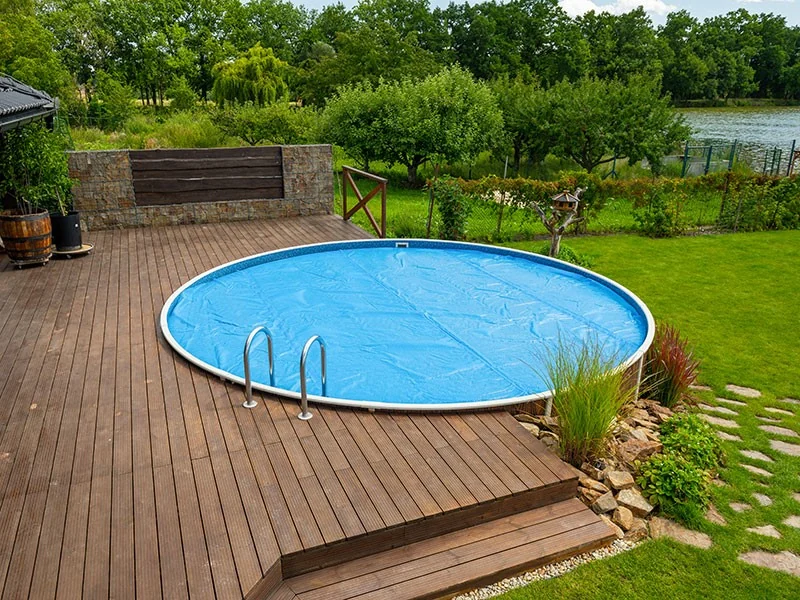
To extend the swimming season, combine three measures: a cover, a solar panel and a heat pump. The cover keeps the heat in at night, the panel adds solar heat during the day, and the heat pump heats the water on cooler days too. At Baseini.NET we offer all three, so you can use your pool earlier in spring and later in autumn.
In short:
- The cover keeps the heat in the pool at night, especially at the start and end of the season.
- A solar panel raises the water temperature by up to 6 °C during the summer season compared with an unheated pool.
- A heat pump works most efficiently at an air temperature of +15 °C and above.
- Pool water should not exceed 30 °C, because that creates conditions for algae.
- The best result comes from a cover combined with a solar panel or a heat pump.
Which measures extend the swimming season best?
The swimming season is extended best when the cover is combined with a heat source. The cover retains the heat, while the panel or the heat pump adds it. The table shows what each measure does.
| Measure | What it does | When it is most useful |
|---|---|---|
| Cover | Keeps the water warm overnight | At the start and end of the season |
| Solar panel | Heats the water with solar energy, by up to 6 °C | On sunny days, for a pool with a sand filter |
| Heat pump | Heats the water independently of the sun | At an air temperature of +15 °C and above |
| Thermometer | Displays water temperature | Throughout the season |
How does a solar pool panel work?
A solar panel heats the water that the filter pump sends through it. Cold water from the pool passes through narrow channels, is warmed by the sun and returns to the pool. The panel is made of polypropylene and does not collect limescale. It is intended for pools with a pump and a sand filter.
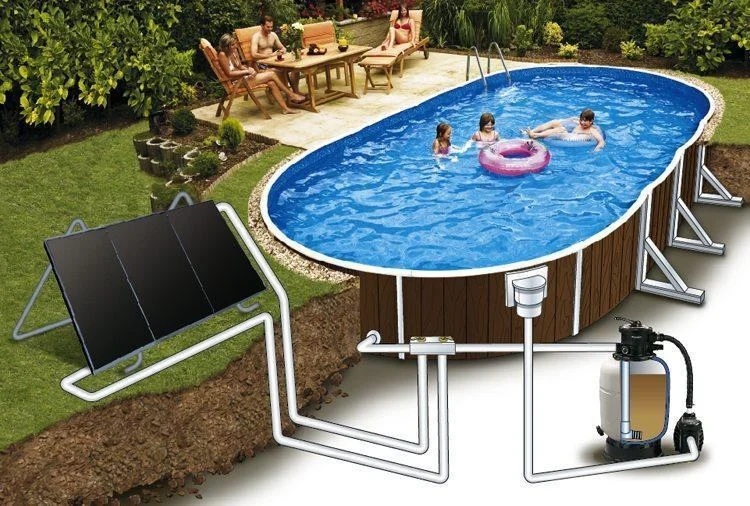
When properly installed, a solar panel raises the temperature by up to 6 °C during the summer season compared with an unheated pool. In cloudy or rainy weather the panel works less well. After one or two sunny days the water warms up again.
Which solar panel should we choose for our pool volume?
A solar panel is chosen according to the pool volume. For pools of up to 20–25 m³, a 3.6 m² pool panel is suitable, and for pools of 30–45 m³ – a 5.4 m² panel. The price of the first starts from 174,40 €.
For an above-ground pool of up to 15 m³ there is the Slim 1.8 m² panel. Panels can be connected to one another. A solar panel smaller than recommended does not give a satisfactory result. In cooler mountain areas a larger area is recommended. More models are available in the pool solar heating category.
Where and how is a solar panel installed?
A solar panel is installed in a place with plenty of direct sunlight. Follow these steps:
- Choose a spot that gets sun for at least 6 hours a day.
- On a sloping surface, orient the panel to the south or south-west.
- A tilt between 30 and 45 degrees is optimal for the period from May to September.
- Place the panel at least 1.5 m from the pool, so that it does not make it easier for children and pets to reach the water.
- Fasten the panel firmly to a stand or to a sloping surface, for example a roof.
- Connect the panel to the filter outlet, with no valves or filter tanks between it and the return nozzle.
A solar panel heats the water only while the sun is shining. The manual bypass switches the panel off at night, for example during night-time filtration, so that it does not cool the water. When the pool water reaches 30 °C, the panel should no longer be used.
Why does a pool need a cover?
The cover keeps the heat in the pool at night, especially at the start and end of the swimming season. That is why it works best together with a solar panel: at night the cover retains the heat that the panel supplied during the day.
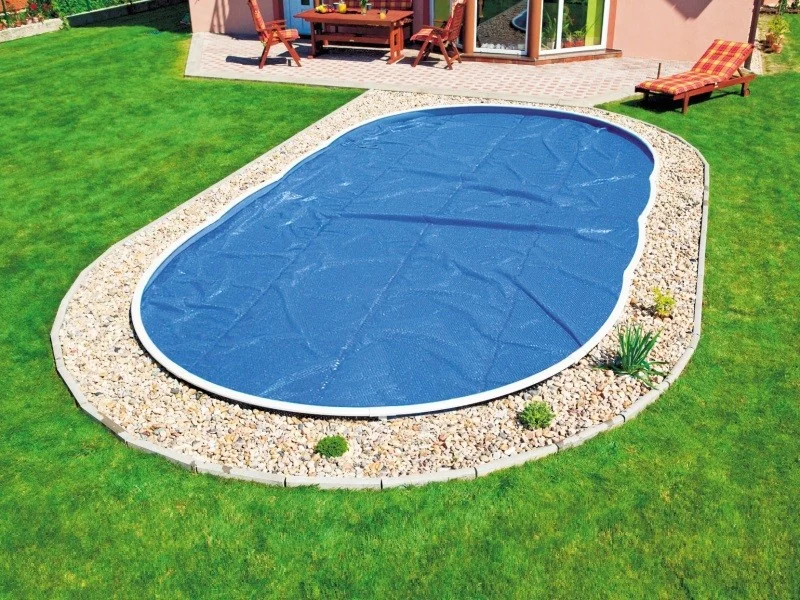
On hot summer days the cover is removed. Direct sunlight warms the water deeper than the cover material does. The solar cover is also removed during shock chlorination, and in winter it is rolled up and not left in the water. A cover is not a substitute for a safety cover or a fence.
At Baseini.NET there are thermal pool covers, for example 180 µ models for round pools measuring 3.6 to 6.4 m. How to choose a solar cover is described in the article how to choose and store a solar cover.
When do you need a heat pump?
A heat pump is needed when you want warm water regardless of the sun. Heat pumps work most efficiently at an ambient temperature of +15 °C and above. With air below 15 °C the coefficient of heat output drops sharply. Heat pumps nearly double the length of the season.
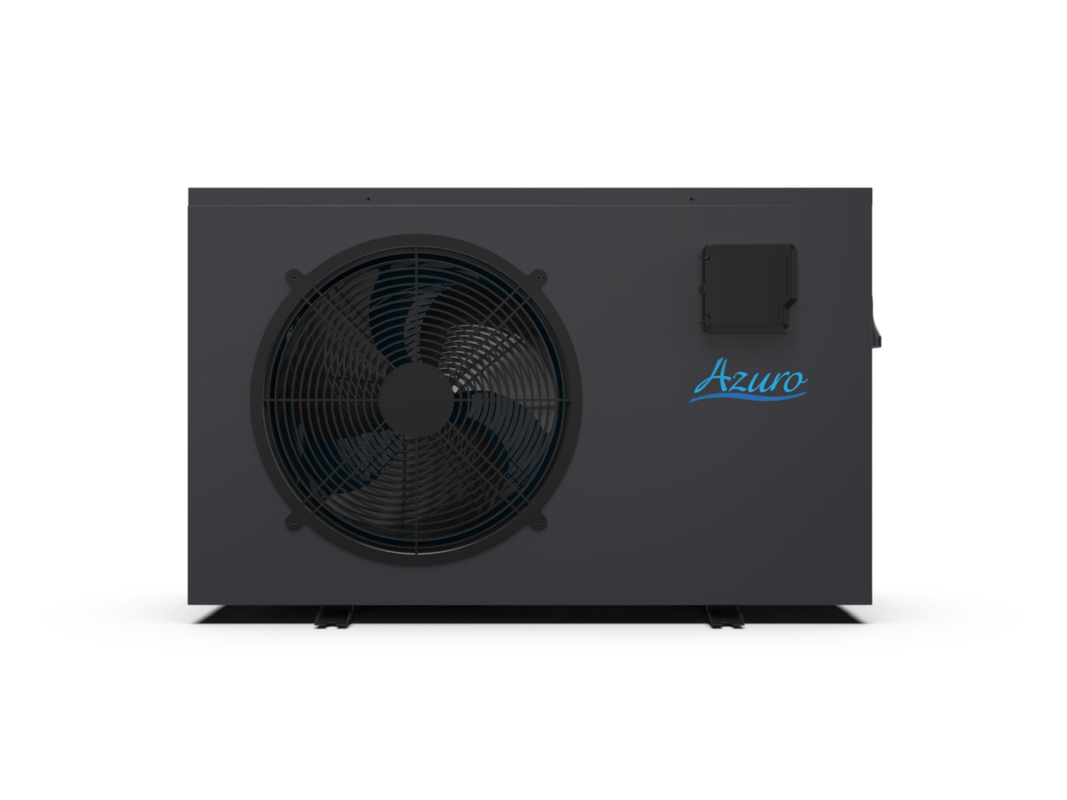
A heat pump is chosen according to the pool volume. The POOLSANA InverPRESTIGE 9 is for a pool of up to about 35 m³, and the InverPRESTIGE 11 up to about 45 m³. The InverPRESTIGE 11 has an operating range from -7 °C to +43 °C. The filter pump must provide at least the minimum flow of the heat pump – 4.9 m³/h for the InverPRESTIGE 11.
The capacity is chosen following the rules in the article how to choose the capacity of a heat pump. Models are available in the pool heat pumps category.
How do we keep track of the water temperature?
The water temperature is monitored with a floating thermometer. The large round Atlas Pool thermometer has a 19 cm dial and a scale from 0 °C to 50 °C, and needs no batteries. Throughout the swimming season the thermometer shows from a distance whether the water is pleasant. That way you can see. Models are available in the pool thermometers category.
Also watch the upper limit of the swimming season. Above 30 °C the water is no longer refreshing and conditions for algae develop. High temperature can also affect the pool liner.
What should we do at the end of the season?
The swimming season ends when the panel and the cover are put away and the pool is prepared for winter. A winter pool cover is used to protect the water during the cold months. For what to do with the filter and the pump, read the article sand filter in winter.
Frequently asked questions
By how many degrees can a solar panel warm the water?
A properly installed solar panel raises the water temperature by up to 6 °C during the summer season compared with an unheated pool. In cloudy or rainy weather it works less well. After one or two sunny days the water warms up again.
What filter is needed for a solar panel?
Solar panels are for pools with an installed pump and sand filter. The filter pump sends the water through the panel. The connections are for 32/38 mm hoses, and the hose is chosen separately according to the length needed.
When does the heat pump not work efficiently?
A heat pump works most efficiently at an air temperature of +15 °C and above. Below 15 °C the coefficient of heat output drops sharply. That is why, in cooler weather, a model with a power reserve is the safer choice.
Should the cover stay on the pool all summer?
No, on hot summer days the cover is removed, because direct sunlight warms the water deeper than its material does. It is most useful at the start and end of the swimming season. The solar cover is also removed during shock chlorination.
Can the pool water be warmer than 30 °C?
It is not recommended. Above 30 °C conditions for algae develop, and in a pool with a liner the liner may stretch. The filter pump can also overheat, so at 30 °C switch off the solar panel.